
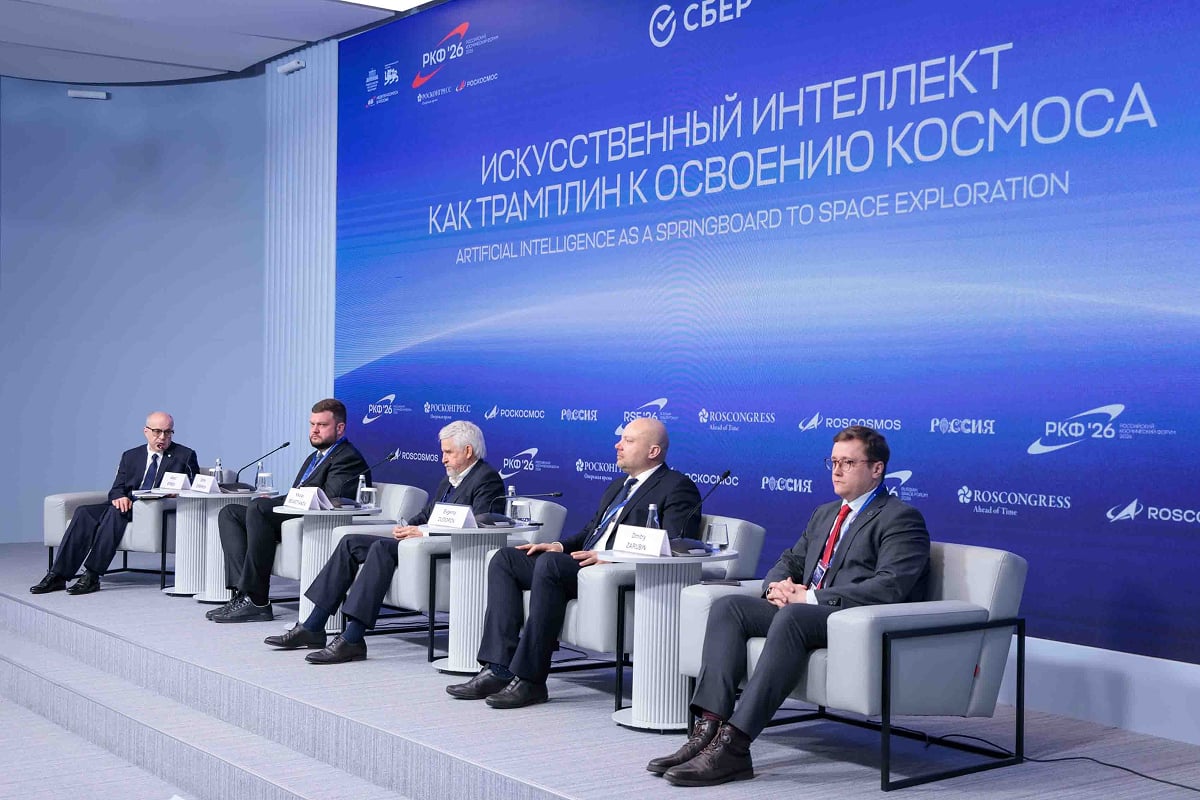
At the First Russian Space Forum, one of the most ambitious topics was discussed: artificial intelligence in space. The session entitled “Artificial Intelligence as a Springboard to Space Exploration” brought together participants to examine how modern technologies, and above all AI, are transforming approaches to the exploration of outer space and what role Russia may play in this process. The Forum is organized by the State Corporation Roscosmos with the support of the Government of the Russian Federation. The operator is the Roscongress Foundation. The First Russian Space Forum is held as part of Space Week 2026.
The contemporary space race is entering a new dimension. Ten years ago, such topics did not attract the same level of attention. Space ambitions are once again becoming relevant. A system has been developed to enable communication between crews in orbit and artificial intelligence, representing an important step within a broader programme of work. The significance of orbital activity is increasing. The creation of a new generation of equipment in the late 1980s significantly expanded the capabilities of cosmonauts. As modern systems grow more complex, artificial intelligence can serve as an information platform, facilitating adaptation to work in space conditions. Today, the possibilities are virtually limitless, provided there is the determination to bring developing technologies to completion.
“Personnel will be able to draw on the vast experience and extensive knowledge accumulated over many years and proven over time. Artificial intelligence can create virtual simulators that replicate extravehicular activity. By putting on a headset, one can feel as though they are on a space station without constructing a physical mock-up. This allows for the simulation of emergency scenarios and the preparation of specialists for a wide range of challenges. The requirements for people remain straightforward: knowledge, skills and the ability to work with modern digital products. We have all the necessary programmes and components to deliver high-quality training. We cooperate continuously with universities, provide additional training, and recognize that learning is a lifelong process”, emphasized Dmitry Gorshkov, Director of the Digital Transformation Department, Roscosmos State Corporation for Space Activities.
AI systems supporting decision-making must continue to develop in order to advance further. Communication with Earth may be difficult, and it is artificial intelligence that can assist by answering critical questions.
“A robot in space is an extension of human capability. It becomes a reliable assistant, capable of performing tasks in conditions that may be dangerous or inaccessible for humans”, noted Evgeniy Dudorov, Deputy General Director, Robotics Corporation; Chairman of the Board, Consortium of Robotics and Intelligent Control Systems. All operations in the coming decades will remain under human supervision and intervention. The risk of error remains significant. While we can already speak of the development and application of robotic systems in space, such systems must be both autonomous and controlled by humans. Any action that leads to the failure of a robot effectively nullifies the mission.
“A key factor is the arrival of young professionals, who bring fresh ideas, innovative approaches and new energy. Young specialists often possess the courage to experiment”, highlighted Dmitry Zarubin, Leading Engineer, Space Research Institute of the Russian Academy of Sciences.
The session demonstrated that Russia has the potential to play an active role in the new space race, provided there is a bold approach to the adoption of innovative technologies and a sustained commitment to workforce development.