
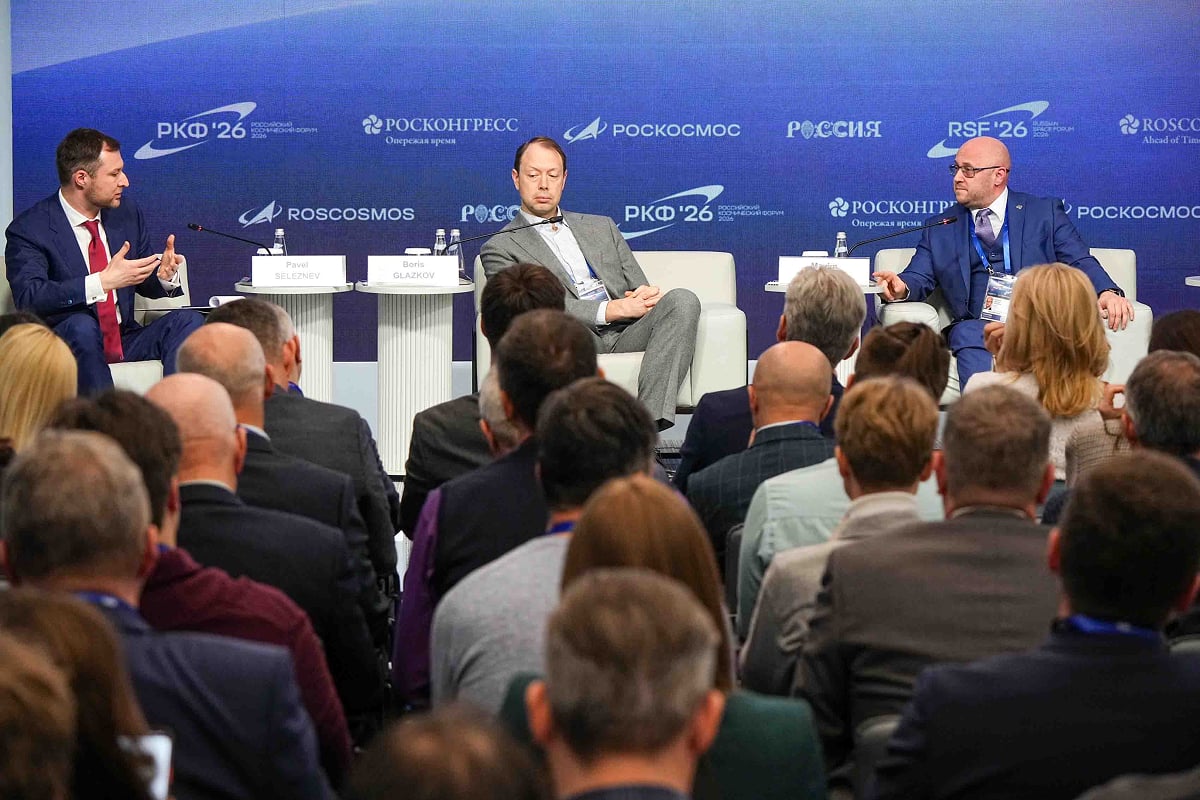
As part of the Russian Space Forum, participants discussed the application of Earth remote sensing (ERS) technologies in the economy. The session entitled “Earth Remote Sensing: How Satellite Data Becomes the Foundation of the Economy” focused on the development of ERS, the integration of satellite data into information systems, and the formation of regulatory approaches for the industry. The Forum was organized by Roscosmos with the support of the Government of the Russian Federation, and operated by the Roscongress Foundation. The First Russian Space Forum is being held as part of Space Week 2026.
Space technologies have long ceased to be purely scientific achievements and have become an invisible foundation of the modern economy. Today, terabytes of high-precision Earth observation data are already being used to solve practical problems in agriculture, environmental monitoring, urban planning, transport, and resource management making space an integral part of everyday life for both citizens and businesses.
During the session, particular attention was paid to the development of the ERS data market and the mechanisms for its growth, including public-private partnerships.
“At present, a market for space data is being formed in Russia through the deliberate creation of regulatory conditions and supply chains. For a long time, such data was provided free of charge, which limited both supply and quality. Today, a model is emerging in which government customers purchase data from private providers, ensuring investment inflows into the industry. Public-private partnership mechanisms and coordination between the state and business play a key role in this process,” said Boris Glazkov, Deputy General Director for Strategic Development, Roscosmos State Corporation for Space Activities.
Participants also discussed market potential and the formation of sustainable demand for remote sensing data.
“The current stage of industry development is associated with a number of systemic changes. In particular, the use of data from non-governmental satellites is gaining priority, creating additional incentives for investment. At the same time, mechanisms for market-based pricing are being established. Significant demand potential lies in the regions, where there remains a need to develop competencies and implement ERS services. In this context, public-private partnership models are especially important, enabling private companies to participate in deploying and developing ERS services in the regions,” emphasized Alexander Minov, General Director of MT-Lab.
The discussion also covered the development of government digital platforms and the integration of data into decision-making processes.
“The development of the Unified Digital Platform ‘National Spatial Data System’ is aimed at ensuring broad online access to up-to-date geospatial information. The platform is already used by several federal executive bodies and major companies. By 2028, it is expected to become a fundamental tool for all regions and agencies, creating a unified information space for decision-making,” noted Maxim Smirnov, Deputy Head, The Federal Service for State Registration, Cadastre and Cartography (Rosreestr).
Special emphasis was placed on financial instruments that support infrastructure renewal and reduce barriers to market entry.
“Leasing mechanisms can become an effective financing tool for space projects. A spacecraft is a capital-intensive asset with a limited operational lifespan; leasing allows the financial burden to be distributed and ensures timely renewal of satellite constellations through reinvestment. This approach opens additional opportunities for attracting investment and improving the sustainability of business models in the sector,” said Alexey Kukanov, Director of the Directorate of Unmanned and Intelligent Systems, GTLK.
Finally, participants discussed the prospects for the commercial segment of the data market.
“In our business models, we have always viewed government contracts as a form of support. However, significant potential lies in the B2B segment. We have experience developing software for data storage and processing: our AIS platform is already attracting strong interest from companies and enterprises,” noted Milana Elerdova, First Deputy General Director of Sputniks Group.
Other participants in the discussion included: Pavel Seleznev, Senior Managing Partner for PPP, VEB.RF; Konstantin Tsyganov, First Deputy Minister of Natural Resources and Environment of the Russian Federation; Andrey Emelyanov, Project Director – Deputy General Designer, Russian Space Systems; Natalia Zavyalova, Head of the Radar Algorithms Research Laboratory, Moscow Institute of Physics and Technology; Azamat Khochuev, Director of the Department for Development of the Northern Sea Route and the Arctic, State Atomic Energy Corporation Rosatom.