
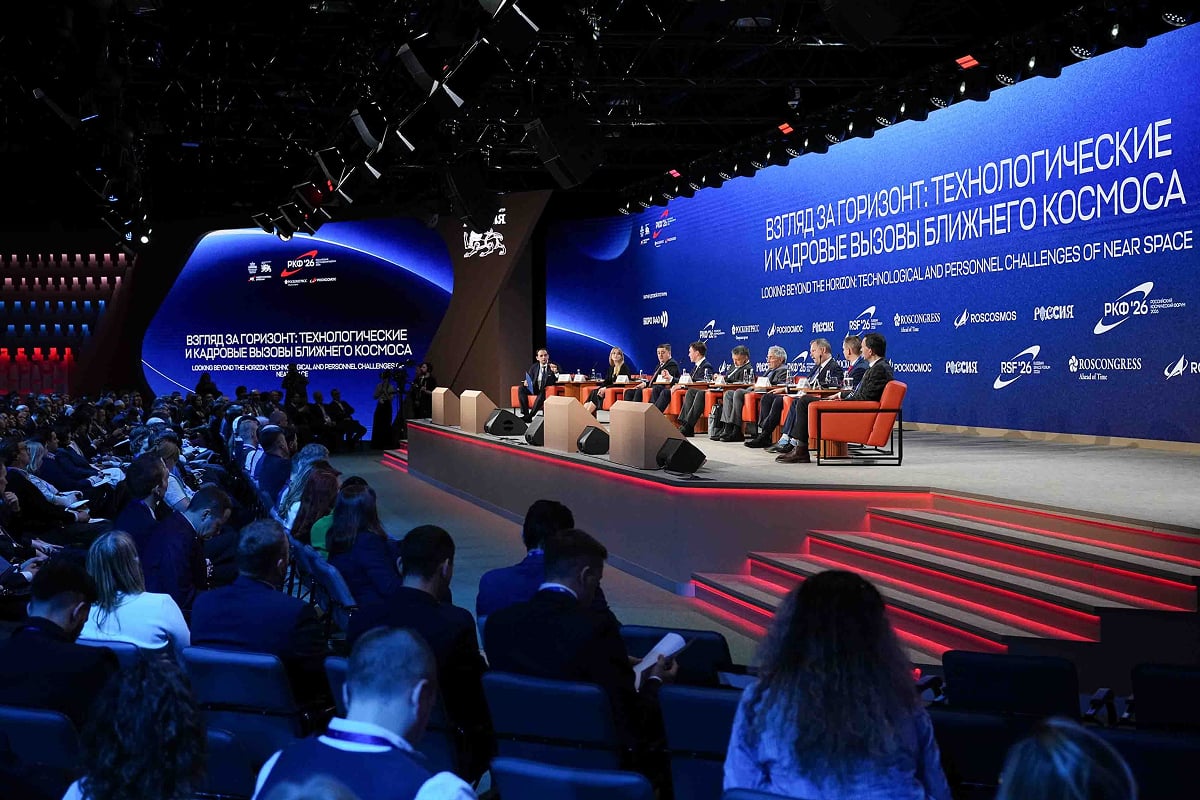
As part of the First Russian Space Forum, the session entitled "Looking Beyond the Horizon: Technological and Personnel Challenges of Near Space" was held, focusing on the prospects for the development of the low Earth orbit economy. The Forum is organized by the Roscosmos State Corporation for Space Activities with the support of the Government of the Russian Federation. The operator is the Roscongress Foundation. The First Russian Space Forum is held as part of Space Week 2026.
The discussion focused on the key technological and workforce challenges shaping the development of the space sector in the coming decades. Participants examined issues related to the transformation of space into a fully-fledged market, the development of satellite communications and hybrid communication systems, the digitalization of production processes, as well as the prospects for creating new launch vehicles, including reusable rockets. Particular attention was given to the training of specialists capable of working with breakthrough technologies and to the formation of a sustainable educational ecosystem.
"The prospects for the development of the sector are directly linked to technological advancement: it is this that becomes the point of breakthrough and forms the foundation for the future orbital economy," said Yana Harlan, Head of the Propulsion Department, Curator of Academic Programs, BUREAU 1440.
During the discussion, it was noted that the space sector is undergoing a phase of structural transformation: the role of digital solutions is increasing, there is a growing demand for new engineering approaches, and the boundaries between near and deep space are being reconsidered. It was also emphasized that the development of satellite constellations and data transmission systems requires the implementation of new technological solutions, including phased array antennas and hybrid networks integrating space, stratospheric and ground-based levels.
"Space is becoming a fully-fledged market, and in these conditions it is necessary to develop new approaches to design and production, including the creation of modern rocket systems and the improvement of technological processes," said Grigory Maximov, Deputy General Director for Production, Roscosmos State Corporation for Space Activities.
A significant part of the discussion was devoted to the workforce agenda. Participants highlighted the need for early career guidance, the involvement of school and university students in real engineering projects, and the creation of conditions for forming teams capable of implementing complex technological solutions. The role of state support programmes was noted, as well as initiatives by educational institutions and businesses to develop practice-oriented training, including small satellite competitions and student project teams.
"Workforce development requires a systematic approach: it is important not only to train specialists, but also to create opportunities for their practical application. Education is a long-term process, and the key task is to form teams capable of working with the technologies of the future," said Alexander Vedekhin, Deputy Director of the Department of State Youth Policy and Educational Activities, Ministry of Science and Higher Education of the Russian Federation; Administrator of the Federal Project "Personnel for Space".
The session also addressed long-term scientific prospects, including the development of planetary research and the creation of new types of power systems for space missions. Participants emphasized that further development of the sector will require the integration of scientific research, engineering solutions and new approaches to data management.
The session was moderated by Anton Alekseev, General Director, "New Space" Corporation for Aerospace Activities.
Participants in the discussion included: Maksim Vakshtein, General Director, Foundation for Advanced Research; Mikhail Gordin, Rector of Bauman Moscow State Technical University; Elena Druzhinina, Managing Director for Cooperation between Science and Business at Rostec State Corporation; Lev Zeleny, Academician, Russian Academy of Sciences, Scientific Director, Institute of Space Research of the Russian Academy of Sciences; Andrey Ionin, Vice President of Strategy, Technological Sovereignty Export Association; and Anton Rogachev, Leading Engineer, Lomonosov Moscow State University.
The session confirmed that space is becoming a new infrastructural environment that brings together various industries and technologies. The development of the near-Earth economy, digital services and human capital is seen as a key condition for building a sustainable and competitive space sector.