
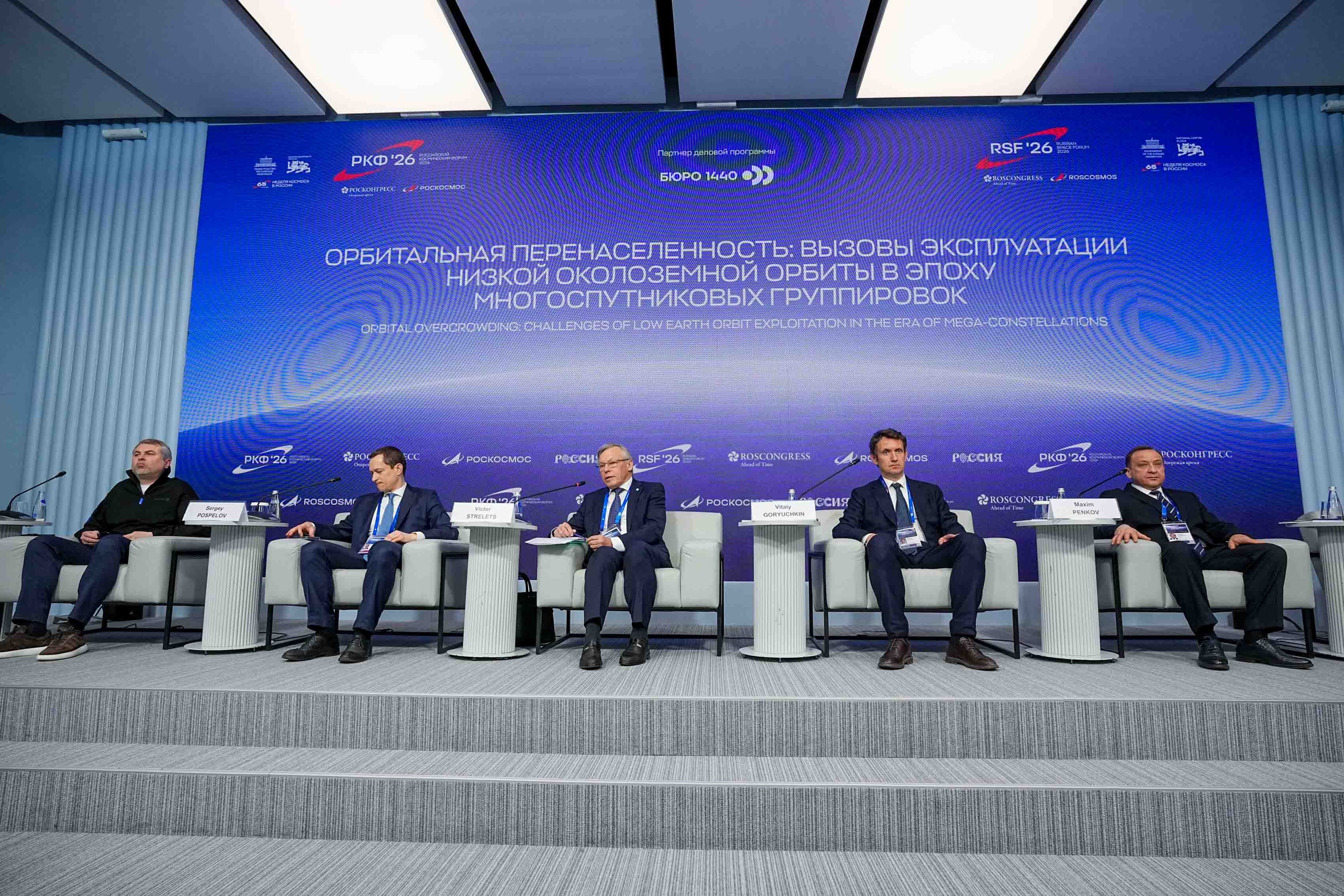
As part of the Russian Space Forum, participants discussed one of the key challenges facing the modern space industry: the operation of low Earth orbit amid the rapid growth of large satellite constellations. The focus was on developing coordinated approaches to managing orbital space, improving mechanisms for coordination and data exchange, and ensuring the safety and sustainability of space infrastructure. The Forum was organized by Roscosmos with the support of the Government of the Russian Federation, with the Roscongress Foundation serving as the operator. The First Russian Space Forum is being held as part of Space Week 2026.
During the discussion, participants emphasized that the current stage of industry development requires a shift from fragmented practices to systematic coordination, both at national and international levels. In the context of growing multi-orbit constellations, analyzing existing procedures and developing harmonized approaches is crucial to reducing risks and ensuring market scalability.
"To enter international markets, it is necessary to take into account the national requirements of each country: from licensing to security and localization issues," noted Artem Ikoev, Deputy General Director for Technology of X Holding. As orbital density increases, the quality of data becomes critical, including its accuracy, update speed, and the level of trust between operators, as these parameters determine the ability to prevent collisions and ensure predictability of the orbital environment. "The fundamental elements here are data and trust in that data. Even with various objective monitoring systems in place, the load on infrastructure and the volume of processing remain extremely high. At the same time, large constellations perform thousands of manoeuvres per day, many of which are not recorded in real time, making the modelling of the orbital environment a serious challenge," he added.
Against this backdrop, safety extends beyond individual technological solutions and becomes a matter of coordination across the entire industry.
"To ensure safety, operators must provide high-precision information about the current and projected positions of spacecraft, as well as data on planned manoeuvres. Only in this case is it possible to assess risks in advance and prevent potential incidents," said Vitaly Goryuchkin, Chief Designer of the Space Control System, Interstate Joint-Stock Corporation Vympel.
Participants identified standardization as a key factor for sustainable development, without which neither safety nor scalability of space infrastructure can be ensured.
"The main task is to unify formats and protocols for exchanging information about the position of objects in orbit, as well as data related to their deployment, operation, and end-of-life. We are talking about a comprehensive exchange system where compatibility becomes a critical condition for the safe functioning of the entire orbital infrastructure," said Maxim Penkov, Deputy Director General for Applied Research and Projects in the Field of Ensuring the Safety of Activities in Near-Earth Space, Central Research Institute of Mechanical Engineering.
In addition, participants discussed the prospects for automating management processes and applying artificial intelligence technologies, which are becoming essential for handling the growing volumes of data. The further development of low Earth orbit constellations is impossible without coordinated international approaches, standardized frameworks, and a transition to systemic coordination, where interoperability and data exchange become as strategic a resource as the spacecraft themselves.