
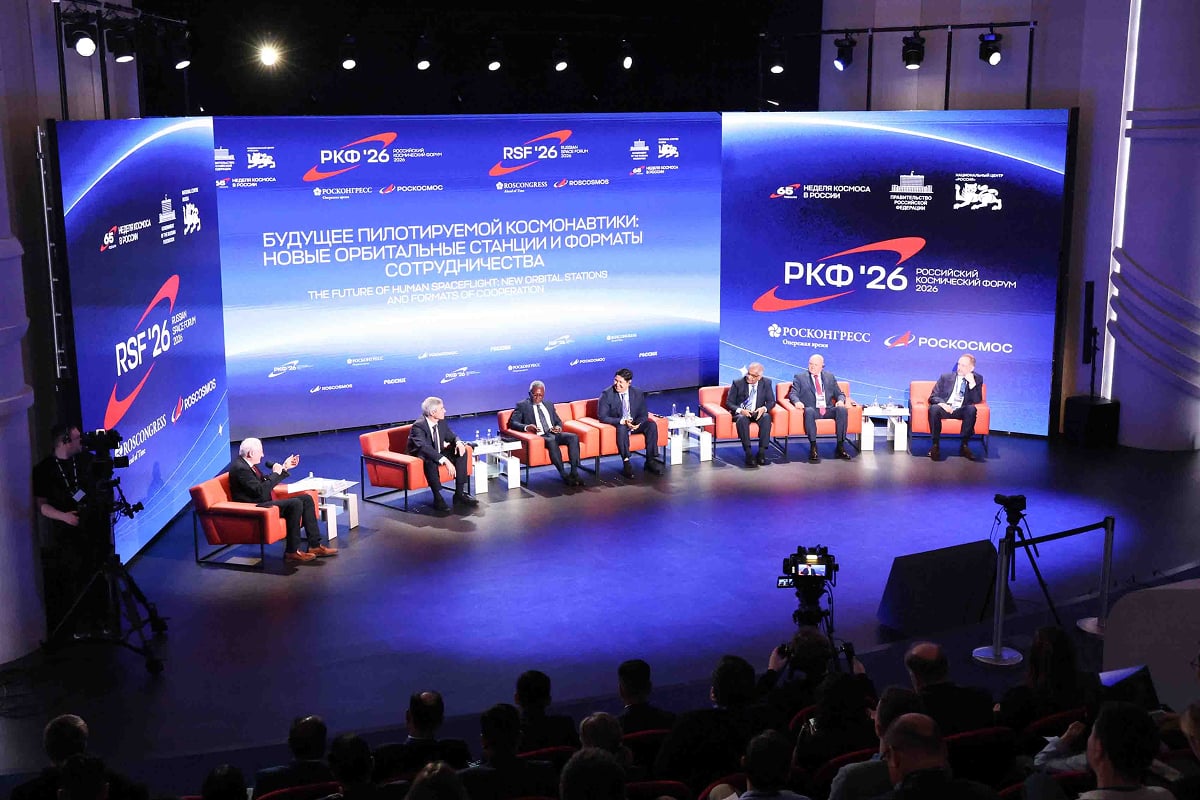
The session 'The Future of Human Spaceflight: New Orbital Stations and Formats of Cooperation' was held today as part of the first Russian Space Forum. The Forum is organized by the Roscosmos State Corporation with the support of the Government of the Russian Federation, and operated by the Roscongress Foundation. The Russian Space Forum is being held as part of Space Week 2026.
In the context of the transition from the International Space Station to national and commercial orbital stations, a new architecture of human spaceflight is being formed, and the Russian Orbital Station occupies a significant place in this. The radical changes that are taking place make creating "bridges" between domestic and foreign space programmes an absolute priority. This includes developing compatible docking ports, conducting joint experiments, and carrying out astronaut training. "National stations don't mean the end of international cooperation. Quite the opposite, the creation of independent space stations could create new opportunities for joint scientific and technological collaboration between countries," noted Sergey Krikalev, Deputy General Director for Manned and Automated Systems at Roscosmos State Corporation for Space Activities.
The key challenge is to maintain the continuity of space programmes and the accumulated competencies of specialists working in the field, as well as to find new formats for international cooperation in space. National space stations do not preclude international cooperation, although the format of cooperation may change. We already have experience of carrying out joint missions, and it is common practice for countries to operate independently on international stations under common coordination.
"Kazakhstan intends to participate in new international space projects within its capabilities, seeking to strengthen its position in the global space research and technology arena," explained Baubek Oralmagambetov, Chairman of the Aerospace Committee at the Ministry of Artificial Intelligence and Digital Development of the Republic of Kazakhstan.
Moving forward, the Russian Space Station will replace the Russian segment of the International Space Station, but cooperation will continue in the form of joint flights and experiments. Cooperation programmes can be developed between multiple stations, including cross-flights of astronauts on different spacecraft. Interaction between stations in different orbits will create opportunities for joint research. Emphasis will be placed on international collaboration, and several countries have already expressed interest in participating in joint projects.
"Belarus and Russia are strategic partners in space technology, which is what has allowed Belarus to become involved in human spaceflight projects," stated Ivan Bucha, Deputy Head of Aerospace Operations Directorate at the National Academy of Sciences of Belarus.
The transition from the International Space Station to national and commercial stations is shaping a new architecture for human spaceflight, and the Russian Orbital Station plays a key role in this. The transformations that are taking place make creating links between domestic and foreign space programmes an absolute priority, including the development of compatible docking ports, conducting joint experiments, and astronaut training.